
A brand North Star is a single sentence that captures the idea your whole business is built around. It isn't a tagline or a mission statement. It's an internal filter: before you post, run a promotion or change your website, you ask whether it fits the North Star. If it doesn't, you don't do it.
Every small business owner makes dozens of marketing decisions a month. Which post to share. Whether to run a promotion. What to put on the homepage. How to answer a bad review.
Without a clear reference point, each of those decisions gets made from scratch, usually based on whatever feels urgent or whatever a competitor just did. That's exhausting, and it's why so much small business marketing feels scattered.
A North Star fixes that. It's one sentence that does the deciding for you.
What is a brand North Star?
A North Star is the core idea of your brand, written in plain language. It describes what you want people to feel about your business, in a way that's specific to you.
It's easy to confuse with other brand statements, so here's how they compare:
| Who it's for | What it does | Example | |
|---|---|---|---|
| North Star | You and your team | Guides every marketing decision | "The first dentist kids aren't scared of." |
| Tagline | Customers | Gets remembered in ads and signage | "Smiles start here!" |
| Mission statement | Investors, staff, the About page | Describes your purpose broadly | "To provide quality dental care to families in our community." |
A tagline might come out of your North Star, and your mission might sit alongside it. But only the North Star is specific enough to tell you what to do on a Tuesday afternoon.
What makes a good North Star?
Strong North Stars share four traits:
- Specific. It couldn't belong to just any business in your category. "Great service" fails this test. So does anything with the word "quality."
- True. It describes something you actually deliver, and your customers would agree with it. A North Star you can't live up to is worse than none.
- Different. It claims ground your competitors aren't standing on. If the dentist down the street could say it too, keep going.
- Useful as a filter. You can hold a marketing idea up against it and get a clear yes or no.
Notice what's not on the list: clever. A North Star doesn't need to be catchy. It needs to be clear.
What do good North Stars look like?
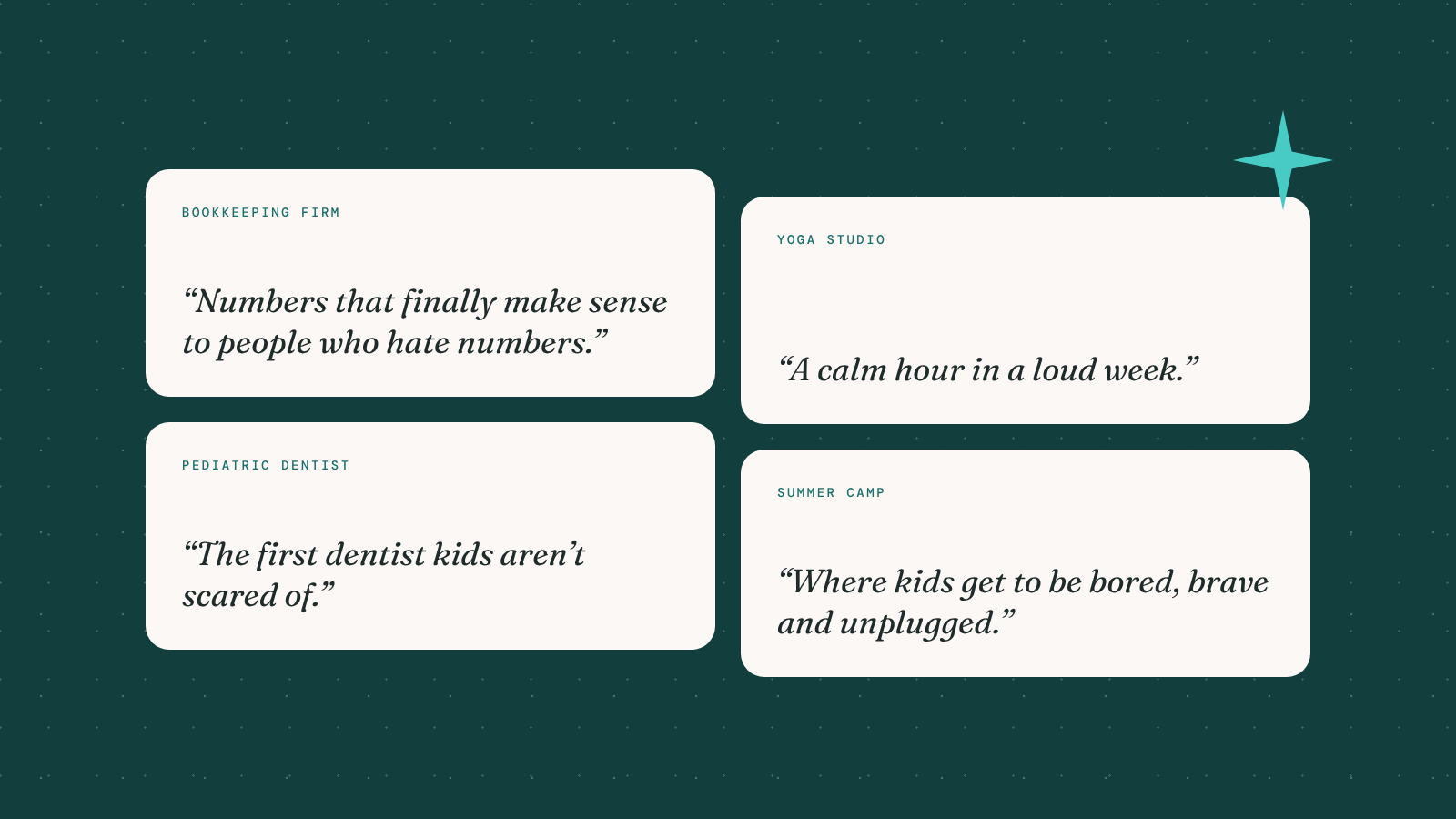
Here are four examples from very different businesses, along with what each one rules in and rules out.
A bookkeeping firm for creative freelancers
"Numbers that finally make sense to people who hate numbers."
Rules in: plain-English explainers, short videos that walk through a tax form line by line, a friendly tone that never makes clients feel behind. Rules out: jargon-heavy posts about tax code changes, stock photos of calculators, anything that sounds like a bank.
A neighborhood yoga studio
"A calm hour in a loud week."
Rules in: slower classes, low lighting, emails that feel like a deep breath, a front desk that never rushes anyone. Rules out: high-intensity challenges, loud promotions, "beach body" anything.
A pediatric dentist
"The first dentist kids aren't scared of."
Rules in: office tours for nervous kids, videos where children explain the visit in their own words, parent testimonials about first appointments. Rules out: generic whitening promotions, clinical before-and-after photos, anything aimed at adults.
A summer camp
"Where kids get to be bored, brave and unplugged."
Rules in: phone-free messaging, stories about kids trying something new, photos of rainy-day card games. Rules out: adding a coding camp to compete with tech camps, promising nonstop activities.
A North Star isn't what you say to customers. It's what you say to yourself before you say anything to customers.
How do you write your own North Star?
You can draft a solid North Star in an afternoon. Here's how.
- List what your best customers say about you. Look at reviews, texts and things people tell you in person. Pay attention to how they describe the feeling, not just the service.
- List what your competitors claim. Read their websites and social posts. Write down the promises they all make.
- Find the overlap and the gap. What do your best customers value that your competitors aren't talking about? That's your ground.
- Write it as one sentence. Plain words. No industry jargon. Aim for under 12 words.
- Test it. Hold your last ten marketing decisions up against it. Would it have told you what to do?
Most first drafts are too generic. That's normal. Keep sharpening.
A family-owned plumbing company, three drafts in:
Draft 1: "Quality plumbing services you can count on." Every plumber says this.
Draft 2: "Plumbers you can trust." Better, but still not specific. Trust in what?
Draft 3: "The plumber who shows up when they say they will." Specific, true (their reviews say it constantly), different (the biggest complaint about competitors is no-shows) and useful. It tells them to post about arrival windows, text customers when they're on the way, and never overbook.
How do you use a North Star day to day?
Once you have one, put it everywhere your team makes decisions: the top of your marketing plan, the inside of your content calendar, the notes app on your phone. Then use it as a quick check before anything goes out:
- Does this sound like us, or could any business in our category post it?
- Does it reinforce the feeling in our North Star, or work against it?
- Would our best customers recognize us in it?
- If we did only this one thing this week, would it move our brand in the right direction?
If a post, promotion or idea fails these questions, skip it, even if a competitor is doing it. Especially if a competitor is doing it.
Where should you start?
Your North Star is the first of the five decisions in a brand strategy. If you haven't read it yet, start with what a brand strategy really is. And if your marketing feels busy but isn't working, the reason is often a missing message behind your tactics.
Brandful writes your North Star for you. It studies your website and your competitors, then drafts a North Star and the rest of your brand strategy for you to edit and approve. Every step in your marketing plan traces back to it.
Frequently asked questions
What is a North Star in branding?
A North Star is a single sentence that captures the core idea of your brand. It's used internally to guide marketing decisions, rather than as a slogan for customers.
Is a North Star the same as a tagline?
No. A tagline is written for customers and designed to be memorable. A North Star is written for you and your team and designed to be useful. Your tagline can come from your North Star, but they do different jobs.
How long should a brand North Star be?
One sentence, ideally under 12 words. If you need two sentences to explain it, it's probably trying to do too much.
Can a small business have a North Star?
Yes, and it's especially useful for small businesses. With limited time and budget, a North Star helps you say no to ideas that don't fit and focus on the ones that build your brand.
How often should you change your North Star?
Rarely. A good North Star should hold for years. Revisit it if your business changes in a big way, like a new audience, a new core service or a major shift in your competition.