
When small business marketing isn't working, the tactic is rarely the problem. Usually there's no clear message, no defined audience and no real difference behind it, so every post, ad and promotion starts from zero and nothing builds. Fix those first, and the same tactics start to pay off.
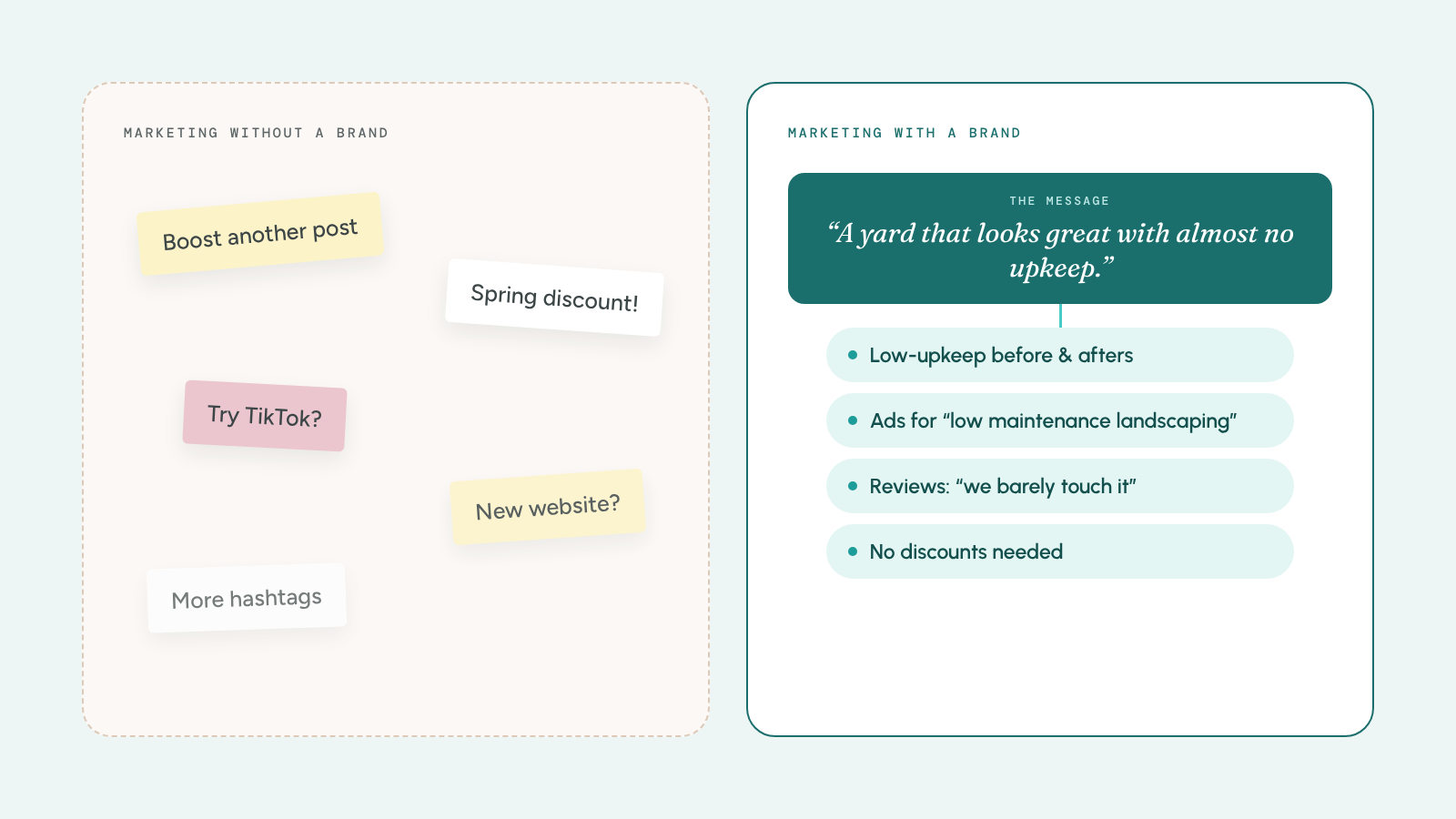
Picture a landscaping company with two crews and a good reputation. The owner does everything the advice says. Before-and-after photos three times a week. A boosted post every month. Google Ads on "landscaping near me." A spring discount on Nextdoor.
The phone rings. But mostly it's people asking for the cheapest quote, and half of them disappear after the estimate. The owner's conclusion: we need to do more marketing. Maybe TikTok. Maybe a new website.
More marketing won't fix it. The problem isn't how much they're doing. It's that nothing they're doing gives anyone a reason to choose them over the other six landscapers in town.
Why isn't my marketing working?
In almost every case, it comes down to one or more of these five reasons.
1. You're saying what everyone else says. "Quality work. Competitive prices. Free estimates." Every competitor says the same thing, so customers can only compare you on price. If your message could appear on a rival's truck without anyone noticing, it isn't doing its job.
2. You're talking to everyone. Marketing aimed at "homeowners" lands with no one in particular. The family that wants a showpiece garden and the landlord who wants the lawn mowed cheaply need completely different messages. Trying to please both pleases neither.
3. Every tactic starts from zero. One week it's a photo, the next a discount, the next a trend. With no thread connecting them, each post has to win attention on its own. Nothing builds recognition, so you never get the benefit of repetition.
4. You're measuring activity, not progress. Posts published and ads running feel like progress. But if you're not tracking whether the right customers are calling, and whether they stick around, you can't tell what's working.
5. You're copying competitors. It's tempting to do what seems to work for someone else. But copying makes you look more like them, which is the opposite of what you need.
More marketing won't fix unclear marketing.
How do I know which problem I have?
Answer these honestly. Each "no" points to one of the five reasons above.
- Could a customer explain what makes you different in one sentence?
- Can you describe your ideal customer in more detail than an age range and a zip code?
- Do your last ten posts, ads and emails share a common message?
- Do you know which of your marketing activities brought in your best customers last quarter?
- Is there anything in your marketing that none of your competitors could say?
If you answered "no" to two or more, the fix isn't a new channel. It's a clearer brand underneath the channels you already use.
What does fixing it look like?
Go back to the landscaping company.
Instead of "full-service landscaping," they get specific. Their best customers turn out to be busy two-income families who want a yard they're proud of but don't have time to maintain. So their message becomes "A yard that looks great with almost no upkeep."
Now the tactics line up behind it. The before-and-after photos show low-maintenance designs and mention how little watering they need. Google Ads shift to searches like "low maintenance landscaping." Reviews start mentioning "we barely have to touch it." The spring discount disappears, because they're no longer competing on price.
Fewer people call for the cheapest quote. More call because they want exactly what this company does.
Nothing about their tactics changed dramatically. They still post photos, run ads and ask for reviews. The difference is that every one of those tactics now says the same thing, to the same people, for the same reason.
That consistency matters. Kantar found that integrated, customized campaigns were 57% more effective than non-integrated ones (Kantar, "Walk the talk: 5 ways marketers can succeed in 2025"). When your tactics work together, each one makes the others stronger.
Should I stop doing marketing tactics?
No. Tactics are how people find you. Posts, ads, emails, reviews and events all matter. The point isn't to do less, it's to make sure everything you do points in the same direction.
Think of it this way: your brand decides what to say and who to say it to. Your tactics decide where and when. When the first part is missing, the second part is guesswork.
If you're not sure what your brand actually is, start with what a brand strategy really is and the five decisions it includes.
Where should I start this week?
You don't need to overhaul everything at once. Try this:
- Write one sentence about what makes you different. Not "quality and service." Something only you could say.
- Name your best customer. Think of the two or three clients you'd clone if you could. What do they have in common, and what do they care about?
- Look at your last ten pieces of marketing. Circle the ones that clearly say your sentence to that customer. Do more of those, and drop the rest.
That's the start of brand-first marketing. If you want help with the rest, Brandful builds your brand strategy from your website and competitors, then turns it into a year-long plan with weekly steps, so every tactic points back to what makes you different.
Frequently asked questions
Why am I getting leads but not customers?
Usually because your marketing attracts people comparing on price. When your message doesn't explain what makes you different, the only thing left to compare is the quote. A clearer brand attracts people who want what you specifically offer.
How long does it take for marketing to start working?
It depends on the channel, but consistent marketing builds over months, not weeks. If you've been at it for several months with little to show, the issue is more likely your message than your patience.
Should I try a new marketing channel if my current ones aren't working?
Not until you've fixed your message. A new channel with the same unclear message will usually get the same results. Once your message is clear, your existing channels often start performing better.
How do I know if my marketing message is clear?
Ask three customers to describe why they chose you. If their answers match what your marketing says, and each other, your message is clear. If they're all different, or you hear "you were close by" and "you were cheapest," it isn't.
What's the difference between brand-first marketing and regular marketing?
Brand-first marketing starts by defining who you are, who you're for and what makes you different, then builds every tactic from those decisions. Regular marketing often starts with the tactic, like "we should be on TikTok," and figures out the message later.