
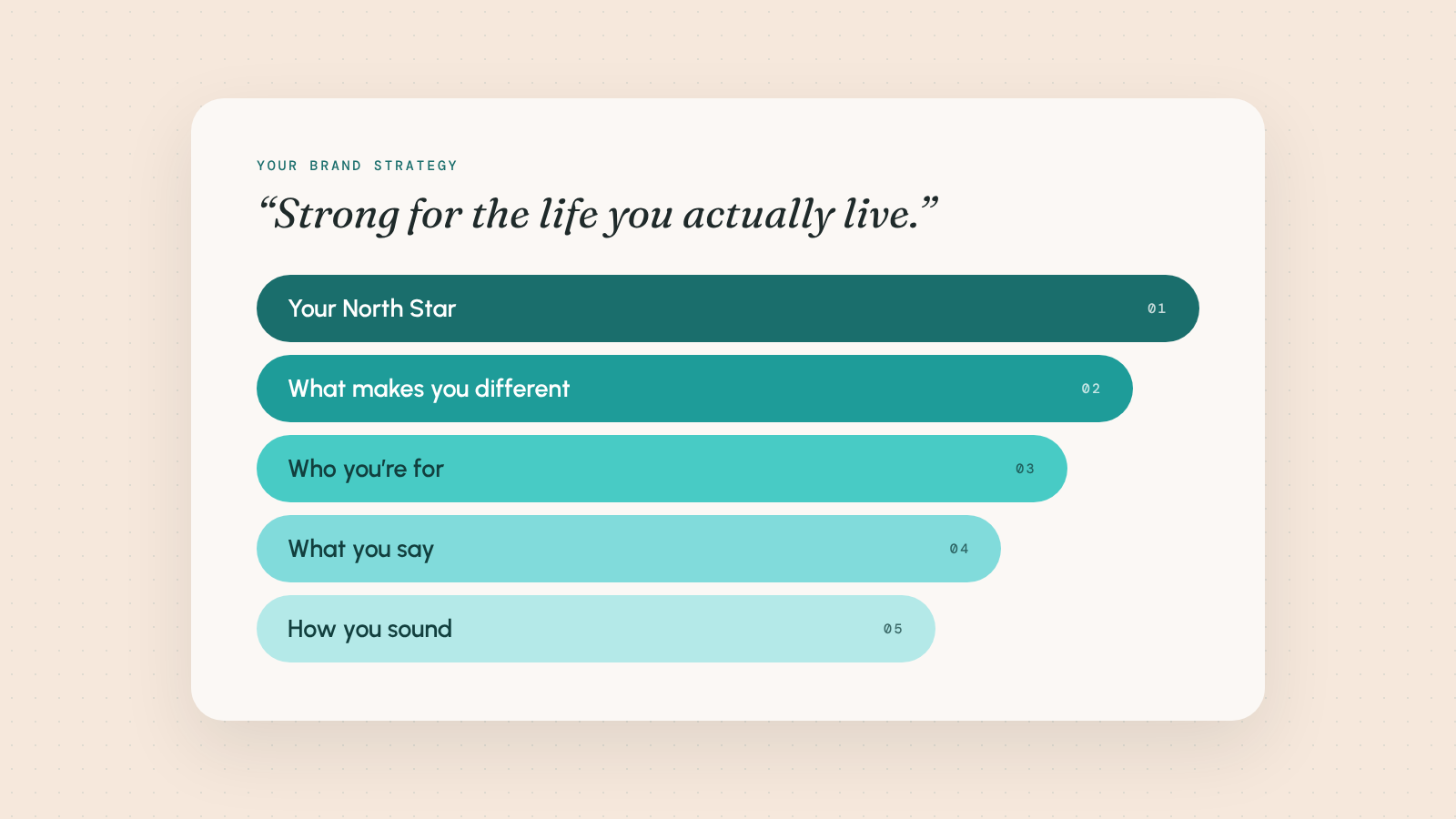
A brand strategy is the short set of decisions about who your business is, who it's for and why someone should choose it over the alternatives. It covers five things: your North Star, what makes you different, who you're for, what you say and how you sound. Every piece of marketing should flow from those decisions.
Ask ten small business owners what a brand strategy is and you'll get ten answers. A logo. A color palette. A mission statement that lives on the About page. A tagline someone paid too much for.
Those are all things a brand produces. None of them is the strategy.
A brand strategy is simpler and more useful than most people think. When those decisions are clear, marketing gets easier. When they're missing, every post, promo and ad is a fresh guess.
Is a brand the same as a logo?
No. Your logo is how people recognize you. Your brand is what they feel when they do.
Think about a place you go back to without thinking about it: a gym, a hair salon, a hardware store. You probably can't describe its logo in detail. But you know exactly what it's like inside, how they treat you, and why you go there instead of the place across town. That feeling is the brand. The logo is just the reminder.
That's why a new logo rarely fixes a marketing problem. If people don't know what you stand for, a fresh coat of paint won't tell them.
Your logo is how people recognize you. Your brand is what they feel when they do.
What are the five parts of a brand strategy?
A brand strategy writes down the decisions that create that feeling, so you can make it happen on purpose. Take a small strength-training studio for people over 40. For a business like that, it comes down to five things:
- Your North Star. One short line that captures the idea your whole business is built around. For the studio, it might be "Strong for the life you actually live." It's not a slogan for customers. It's a filter for every decision you make.
- What makes you different. The ground you can own that your competitors aren't claiming. If every gym nearby sells intensity and six-pack transformations, "strength for everyday life" is open ground.
- Who you're for. Not "everyone." The specific people who will love what you do, and what they care about. "Adults over 40 who want to carry groceries, lift grandkids and stay out of physical therapy" is far more useful than "adults 25–54."
- What you say. A few key messages, each backed by proof. "Coaches who know your old injuries by name" means more when members say it in their reviews.
- How you sound. Your voice. Encouraging or blunt, calm or high-energy. It's what makes a caption sound like you even without your name on it.
That's it. It fits on a page. But those five decisions shape everything that comes after: what you post, which promotions you run (and which you skip), what your website says and how you answer reviews.
Why do so many businesses skip brand strategy?
Most small businesses never get a brand strategy, and it's not because they don't care.
Brand strategy has traditionally been done by agencies and consultants, priced for companies with real marketing budgets. Small businesses (and even bigger ones) often dive right into the tactics. Trying one kind of post today and a different one tomorrow. Search engine marketing focused on broad keywords. Copying what a competitor seems to do well.
Tactics aren't bad. But tactics without a strategy are just guesses that may or may not work. Each one starts from zero, so nothing builds on anything else. You stay busy, but your brand never gets stronger, and customers never get a clear reason to pick you over the next option.
Tactics without a strategy are just guesses that may or may not work.
What changes when you have a brand strategy?
A brand strategy doesn't replace your marketing. It makes your marketing add up.
Decisions get faster. When you know who you are, a lot of choices make themselves.
Should the studio run a "30-day shred challenge" like the big gym down the road? The North Star answers it. A shred challenge says "we're about looking extreme," but the brand is "strong for the life you actually live." So instead, they share a member story: a 62-year-old who can lift her grandson again, filmed in the studio with her coach.
Your marketing gets more consistent. When everything you put out comes from the same few ideas, people start to recognize you. And consistency pays. Brand professionals report that presenting a brand consistently increases revenue by 10–20% (Lucidpress, "The State of Brand Consistency," 2021).
Your tactics start working together. Campaigns that are integrated across channels perform better than scattered ones. Kantar found integrated, customized campaigns were 57% more effective than non-integrated ones (Kantar, "Walk the talk: 5 ways marketers can succeed in 2025").
People feel connected, and connected customers act differently. 76% of consumers say they'd buy from a brand they feel connected to over a competitor (Sprout Social, #BrandsGetReal, 2019). And 81% of emotionally engaged customers promote the brand to friends and family (Capgemini Research Institute, "Loyalty Deciphered," 2017). For a small business, that word of mouth is the most valuable marketing there is.
Trust lets you charge what you're worth. 45% of shoppers say they'll pay more for a brand they trust (Salsify, Consumer Research 2022). A clear brand makes it easier to compete on something other than price.
- 10–20% more revenue from consistent branding
- 57% more effective when campaigns are integrated
- 76% would choose a brand they feel connected to over a competitor
- 81% of emotionally engaged customers recommend the brand
Sources linked above.
How can you tell if you have a brand strategy?
You might already have more of a brand strategy than you think, or less. Try answering these five questions in a sentence each, without looking anything up:
- What's the one idea your business is built around?
- What do you do that your closest competitors don't, or won't?
- Who exactly is your best customer, and what do they care about most?
- What are the two or three things you want every customer to know about you, and how can you prove them?
- If someone read your last five posts without your name on them, would they know they were yours?
If those answers came easily and would match what your team would say, you have a strategy. If they took a while, or you'd get a different answer from everyone you asked, that's the gap. It's also the reason your marketing might feel like a lot of effort for not much return.
Where should you start?
You don't need a 60-page brand book. Start with the five decisions above and write them down in plain language. Then hold every piece of marketing up against them and ask one question: does this sound like us, and does it give people a reason to choose us?
If you'd like a head start, Brandful does this work with you. It studies your website and your competitors, writes your brand strategy, and turns it into a year-long marketing plan with weekly steps that each explain why they matter. Every tactic traces back to your brand, so everything you do makes it stronger.
Frequently asked questions
What's the difference between a brand strategy and a marketing strategy?
A brand strategy defines who you are, who you're for and why people should choose you. A marketing strategy decides how you'll reach those people: which channels, campaigns and budget. The brand strategy comes first, because it tells your marketing what to say.
How long does it take to create a brand strategy?
A full agency process can take weeks or months. For a small business, the core decisions (North Star, what makes you different, audience, key messages and voice) can be drafted in a few focused sessions, then refined as you see what resonates with customers.
Does a small business really need a brand strategy?
Yes, arguably more than a big one. Small businesses have less budget to waste, so every post, ad and promotion needs to work harder. A brand strategy makes sure each one builds on the last instead of starting from zero.
What is a North Star in branding?
A North Star is a single sentence that captures the idea your business is built around. It isn't a customer-facing slogan. It's an internal filter: if a marketing idea doesn't fit the North Star, you don't do it.
How often should a brand strategy change?
Rarely. Your brand strategy should stay steady for years, even as your tactics change. Revisit it when your business changes in a big way, like a new audience, a new offer or a shift in your competition.